September 22, 2026
·By Muhammad Hassan, CEO
Inventory Cycle Counting: The ABC Method
Cycle counting is the practice of counting a small slice of your inventory on a regular schedule, instead of shutting the warehouse down once a year to count everything at once. Done well, it catches a discrepancy within days instead of months, and it never requires closing the doors. Done badly, or not at all, it means the first sign of a problem is a customer order that can’t be filled because the number in your system was wrong.
Why a full physical count isn’t enough on its own
An annual physical inventory has a real place: it’s still the cleanest way to reconcile your books once a year. But as the only check on inventory accuracy, it has an obvious flaw. If a receiving error or a mis-pick happens in February, nobody finds out until the count in December, ten months of orders shipped, POs cut, and reorder decisions made against a number that was wrong the whole time. What real-time inventory actually means is a live number, and cycle counting is how you keep that live number honest between the big annual counts, not instead of them.
The ABC method: not every SKU deserves the same attention
The mistake most small teams make when they try cycle counting is treating every SKU the same, counting everything on the same rotation. That turns into either counting too often to sustain, or too rarely to catch problems early. The ABC method fixes this by splitting inventory into three tiers based on value or sales velocity, not alphabetically:
- A items (roughly the top 10-20% of SKUs by revenue or units moved) get counted most often, often weekly or biweekly. These are the SKUs where a discrepancy hits hardest and fastest, a bestseller that’s actually out when the system says it’s in stock is the dead stock’s opposite problem and arguably the more expensive one.
- B items (the next tier, moderate value or velocity) get counted monthly. Enough attention to catch drift without burning the same effort as your top movers.
- C items (the long tail, low value or rarely moving) get counted quarterly. These carry the least risk per unit, so a full count a few times a year is enough.
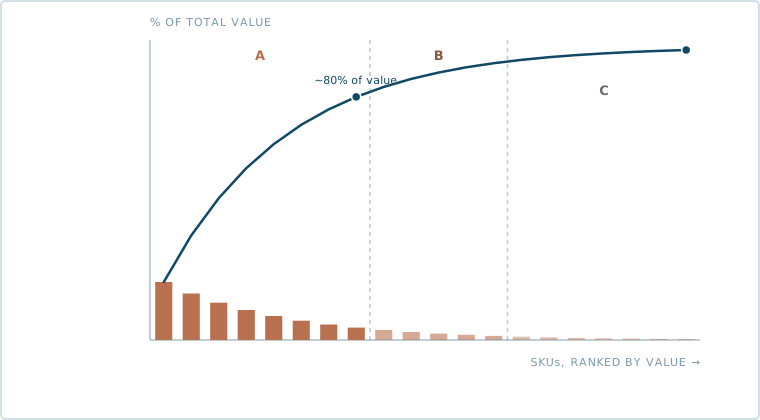
A small slice of SKUs usually accounts for most of the value, which is exactly why they get counted the most often.
A distributor running this consistently, counting A items weekly and B/C items on a longer rotation, can reach accuracy in the high 90s within about six months, mostly because the A-item errors that actually cost money get caught in days instead of quarters.
Running a count without shutting anything down
The reason cycle counting works where a full physical count can’t happen more than once a year is scope: you’re counting a handful of SKUs, not the whole warehouse. A few practices make this sustainable:
Count in small batches during a natural lull. Fifteen to thirty SKUs during a slow hour, not the whole A tier at once. This is what makes daily or near-daily counting realistic without pulling anyone off their actual job.
Count the same way every time. Same starting point, same method (unit count vs. weight vs. pallet count for bulk items), same person double-checking a flagged discrepancy. Inconsistent counting produces noise that looks like shrinkage but is really just measurement error.
Reconcile the same day, not the same week. A discrepancy found Monday and investigated Monday still has a paper trail, a receiving log, a picking ticket, someone’s memory of what happened. By Friday that trail is cold.
Don’t just adjust the number and move on. Inventory shrinkage has a small number of recurring causes: a receiving miscount, a mis-pick that shipped against the wrong order, a return that never got logged back in, or actual loss. If you correct the system number without asking which of those happened, you’ll be back counting the same SKU again next month with no idea why it keeps drifting.
What a discrepancy is actually telling you
A cycle count discrepancy is a symptom, and where it points usually depends on the pattern, not the single event. A SKU that’s consistently a little short points at a process problem, most often picking or receiving. A SKU that’s occasionally wildly off in both directions points at a data entry or system issue, maybe a mismatch across locations if you’re running more than one warehouse. A SKU that’s only ever short, never over, is the pattern worth treating seriously, since that’s the signature of actual loss rather than a counting mistake.
Cycle counting and demand forecasting depend on the same accurate number
An inventory count that’s wrong doesn’t just risk a bad customer promise, it corrupts every downstream decision built on top of it. Demand forecasting works from sales history and current on-hand levels; if on-hand is wrong, the forecast inherits that error. A reorder decision built on a phantom 50 units in stock skips a PO that should have gone out, and the shortfall doesn’t show up until the shelf is already empty. Accurate cycle counts aren’t just a warehouse-floor exercise, they’re the input every other inventory decision depends on being right.
What Flowbound does and doesn’t do here
Flowbound doesn’t physically count your shelves, that’s still a person with a scanner or a clipboard walking the floor. What Inventory Tracking does is keep the baseline number that count gets checked against actually current: real-time visibility into what’s on hand, what’s incoming, and what’s already committed to an order, so a cycle count is comparing physical stock against a number that reflects this morning, not a stale weekly export. That baseline accuracy also feeds Demand Forecasting directly, so the counts you run aren’t just a compliance exercise, they’re keeping the number every reorder decision depends on honest.
FAQ
What is cycle counting? Cycle counting is counting a small portion of inventory on a regular, ongoing schedule instead of counting everything once a year. It catches discrepancies within days rather than months, without requiring a warehouse shutdown.
What is the ABC method for cycle counting? The ABC method splits SKUs into three tiers by value or sales velocity: A items (highest value, roughly the top 10-20%) get counted weekly or biweekly, B items monthly, and C items quarterly. It puts the most frequent attention on the SKUs where a reorder point miss or an unexpected stockout would cost the most.
Does cycle counting replace an annual physical inventory? No. An annual physical count still has a role for full book reconciliation. Cycle counting fills the gap between those counts, so an error from February doesn’t go undiscovered until a count in December.
How often should a small distributor cycle count? There’s no fixed answer, it depends on SKU count and how much risk an error carries. A common structure is weekly for A items, monthly for B items, and quarterly for C items, adjusted based on how much shrinkage or discrepancy each tier is actually showing.
What should you do when a cycle count doesn’t match the system? Investigate before adjusting. Check the receiving log, picking tickets, and recent returns for that SKU first. A discrepancy that’s always in the same direction usually points to a process issue or loss, not random counting error, and real-time inventory tracking makes it easier to spot that pattern instead of guessing from a stale count.