September 11, 2026
·By Muhammad Ali, CFO
Freight Class: What It Is and Why Rates Change
An LTL freight invoice that comes back higher than the quote isn’t always a carrier mistake. More often it’s a reclass, the carrier’s own inspection at the terminal deciding your shipment doesn’t match the freight class it was quoted at, and rebilling it at the class they measured instead. Understanding what freight class actually is, and what determines it, is the difference between catching that before it happens and finding out about it on an invoice weeks later.
What is freight class?
Freight class is a standardized rating system, the National Motor Freight Classification (NMFC), used to price less-than-truckload (LTL) shipments. Every LTL shipment gets assigned one of 18 classes, ranging from class 50 (least expensive to ship) to class 500 (most expensive), and that class is one of the main inputs into what a carrier charges. Two shipments of the same weight and the same distance can have meaningfully different freight costs if they carry different classes, because class reflects more than just how heavy something is.
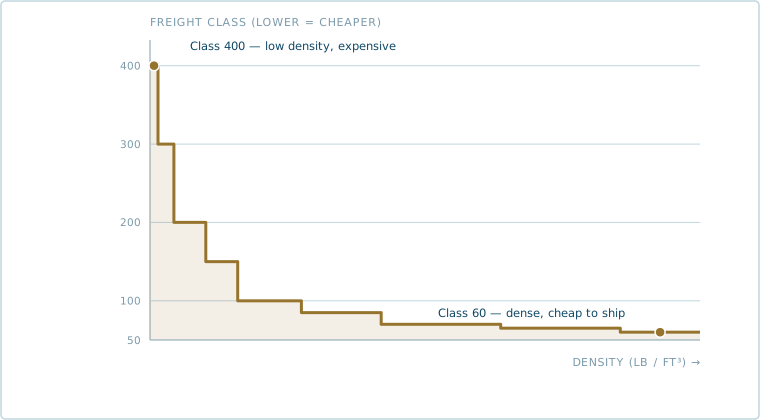
Density alone moves a shipment several classes. It’s usually the single biggest lever on the bill.
The four factors that actually determine your freight class
Density. How much a shipment weighs relative to how much space it takes up, measured in pounds per cubic foot. This is usually the single biggest factor: a dense, compact shipment (metal parts, for example) typically earns a lower, cheaper class, while a bulky, lightweight shipment (empty boxes, foam packaging) takes up truck space without weighing much, which pushes the class, and the cost, higher.
Handling. How much special care a shipment needs moving through a terminal, whether it requires hand loading instead of a forklift, and how fragile or awkwardly shaped it is. Freight that’s easy to palletize and move mechanically rates lower than freight that needs individual attention at every touchpoint.
Stowability. How easily a shipment fits alongside other freight in the same trailer. Hazardous materials, items with unusual dimensions, or freight that can’t be stacked all reduce how efficiently a carrier can fill a truck, and that inefficiency shows up as a higher class.
Liability. The likelihood a shipment gets damaged or lost, or damages other freight around it, based on value, fragility, and susceptibility to theft. Higher-liability freight rates higher, reflecting the real cost a carrier is taking on by accepting it, the same underlying risk that drives shipping damage claims when that liability turns into an actual incident.
Why the same product can get different classes on different shipments
Freight class isn’t a fixed property of a product, it’s a property of that specific shipment as packaged and palletized. The same SKU shipped loose in a box rates differently than shipped shrink-wrapped on a pallet, because the packaging changes density and handling. This is the part that catches distributors off guard: the class quoted when a shipment was booked assumed a certain density and packaging, and if what actually ships doesn’t match that assumption closely enough, the carrier’s own freight inspection at the terminal can reclassify it, and rebill the difference.
Where reclass fees actually come from
A reclass happens when a carrier physically weighs and measures a shipment at their terminal and finds it doesn’t match the class (or the weight) on the bill of lading. The most common cause is an inaccurate density estimate at booking, someone estimated dimensions and weight rather than measuring the actual palletized shipment, and the carrier’s own numbers came out different enough to bump the class up.
The fee itself is usually smaller than the frustration of an invoice that doesn’t match the quote, but it adds up across a shipping volume, and it’s one of the quieter reasons shipping costs creep up over time without an obvious single cause: not one big rate increase, a scatter of small reclass adjustments that don’t get caught unless someone is actually reconciling invoices against quotes shipment by shipment.
How freight class interacts with the LTL vs. parcel decision
Freight class only applies to LTL shipments, not parcel, which is priced primarily on weight and dimensions rather than the four NMFC factors above. That’s part of what makes the LTL vs. parcel decision more complicated than just comparing a quoted rate: a low-density, awkwardly shaped LTL shipment might carry a high enough class that a parcel carrier, or breaking the shipment into smaller parcel-eligible pieces, actually costs less for the same freight, even though the LTL quote looked competitive at first glance.
What actually reduces freight class costs
Measure, don’t estimate, density at booking. The single biggest lever is accuracy: an actual weight and dimension measurement of the palletized shipment, not a rough estimate, is what keeps the quoted class matching what the carrier measures at the terminal, and avoids the reclass fee entirely.
Consolidate and repackage to raise density where possible. Compressing a shipment’s footprint, using a smaller pallet, better stacking, or denser packaging, can genuinely move a shipment into a cheaper class, not just avoid a reclass but lower the baseline rate.
Compare the carrier’s quoted class against your own history for that SKU. If a specific product has been reclassed before, that’s a signal the booking process is estimating its density wrong consistently, not a one-off carrier error, and it’s worth fixing at the source rather than absorbing the fee every time.
Weigh freight class alongside the full carrier and lane comparison, not in isolation. A shipment’s class affects different carriers differently depending on their own rate structures for that class, so the cheapest option for a given shipment isn’t always the one with the lowest headline rate; it’s the one whose combination of class-based pricing and lane happens to fit that specific shipment best.
Letting the comparison happen automatically
Manually checking freight class against a shipment’s actual measurements, and comparing that against every available carrier’s rate for that class and lane, is exactly the kind of repetitive calculation that’s easy to skip when things get busy, which is when reclass fees and suboptimal carrier choices quietly accumulate. Shipping Optimization compares carriers and lanes automatically and recommends the option that gets a shipment there on time for the least cost, so a class-sensitive shipment isn’t defaulting to whichever carrier is easiest to book, it’s weighed against every option every time, the same discipline that applies whether the shipment in question is a routine reorder or a rush order covering for a supplier delay.
FAQ
What is freight class? A standardized rating system (NMFC) used to price LTL shipments, ranging from class 50 (cheapest) to class 500 (most expensive), based on density, handling, stowability, and liability rather than weight alone.
What is the most important factor in determining freight class? Density, pounds per cubic foot, is usually the single biggest factor. A dense, compact shipment typically earns a lower class than a bulky, lightweight one of the same weight, which is also why multi-location inventory decisions can change freight costs, not just warehouse costs.
Why did my freight bill come back higher than the quote? Most likely a reclass: the carrier physically weighed and measured the shipment at their terminal and found it didn’t match the class or weight on the original bill of lading, usually because the booking estimate, not the carrier, got the density wrong.
Does freight class apply to parcel shipments? No. Freight class is specific to LTL shipping. Parcel is priced primarily on weight and dimensions, which is one of the key differences to weigh in the LTL vs. parcel decision for a given shipment.
How can I avoid reclass fees on LTL shipments? Measure the actual palletized shipment’s weight and dimensions at booking instead of estimating, since an inaccurate density estimate is the most common cause of a terminal reclassifying a shipment, along with choosing the right carrier for that shipment’s actual class and lane in the first place.