September 13, 2026
·By Ryo Shibata, CTO
The CAPA Process for Supplier Quality Issues
A supplier sends a bad batch, you send it back, they send a replacement, and everyone moves on. Three months later, the same supplier sends another bad batch, for what turns out to be the same underlying reason. The first response fixed the shipment. It didn’t fix the problem, because nobody ever asked why it happened in the first place. That’s the gap a CAPA process closes, and most small distributors don’t need the heavy, document-driven version built for regulated manufacturing to get real value from the idea.
What CAPA actually means
CAPA stands for corrective and preventive action, and it’s a structured way of responding to a quality problem that goes further than fixing the immediate issue. Corrective action addresses what already went wrong: replacing a bad batch, crediting an account, fixing the specific defect. Preventive action addresses why it happened, so the same failure doesn’t quietly repeat with the next shipment, or the one after that.
Most quality complaints in a small operation only get the corrective half. Something’s wrong, it gets resolved, the ticket closes. That’s often the right call for a genuine one-off, a shipping mishap, a single mislabeled box. It’s the wrong call when the same supplier or the same product keeps generating similar complaints, because at that point the corrective fix is treating a symptom that’s going to return.
When a supplier issue needs a CAPA instead of a one-off fix
Not every defect deserves a full corrective and preventive process, and treating every complaint that way would bury a small team in documentation for problems that genuinely were isolated. The signal to escalate from “just fix this one” to “figure out why this keeps happening” is a pattern, not a single incident: the same defect type from the same supplier more than once, a defect rate that’s trending up rather than holding steady, or a failure serious enough, a safety issue, a batch-wide defect, that even one occurrence justifies asking why before it happens again.
The practical trigger most small teams can use without a formal quality system: if you’ve flagged the same issue with the same supplier twice, that’s no longer a one-off, that’s a pattern asking for a root cause.
The CAPA process, without the enterprise paperwork
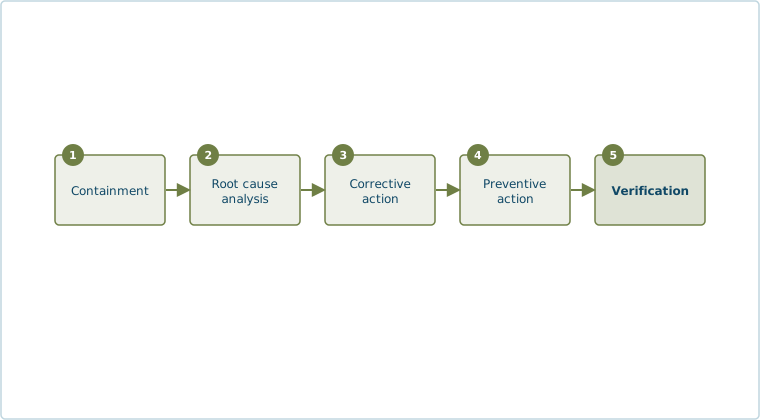
Five steps, in order. Skipping straight from containment to corrective action is what leaves the root cause, and the next occurrence, unaddressed.
Containment. Stop the immediate problem from spreading, hold or return the affected batch, before doing anything else. This is the corrective half, and it’s usually already happening informally even at operations with no formal quality process.
Root cause analysis. This is the step most one-off fixes skip. Ask why the defect happened, not just what the defect was. A recurring dimensional issue might trace back to a tooling problem at the supplier, a material substitution nobody flagged, or a packaging change that’s introducing damage in transit. The actual inspection step most teams skip is often where the root cause analysis should start too, since incoming inspection data is usually the first place a pattern shows up.
Corrective action. Fix the specific instance: replace the batch, issue a credit, rework the affected units. Straightforward, and usually already the part every team does regardless of whether they call it CAPA.
Preventive action. Address the root cause so it doesn’t recur: a supplier commits to a process change, an incoming inspection step gets added for that specific defect type, a specification gets clarified in writing so there’s no ambiguity next time. This is the step that actually earns the “preventive” half of the name, and it’s the one that gets skipped when a team is moving fast and the immediate fix feels like enough.
Verification. Confirm the preventive action actually worked, on the next shipment, not just assume it did because the supplier said they fixed it. A defect rate that drops after the corrective action but creeps back up over the following months means the root cause analysis missed something.
Why small distributors skip this, and what it costs
A formal CAPA process, the kind built for regulated manufacturing, involves designated forms, review boards, and audit trails that make sense for a facility answering to FDA or ISO requirements. A small distributor running a handful of core suppliers doesn’t need that machinery, and building it would be its own kind of waste. But the absence of any structure at all has a real cost: the same supplier issue resurfacing every few months, each time treated as a fresh surprise instead of a known pattern, because nothing connected this complaint to the one three months ago.
The fix isn’t adopting the enterprise version. It’s keeping the five steps above lightweight, and, more importantly, actually tracking supplier issues over time so the second occurrence of the same defect gets recognized as a pattern instead of logged as an unrelated new complaint. A supplier scorecard is the groundwork for this: if a supplier’s history already exists in some form, a root cause conversation starts from evidence instead of a hunch.
Building the case with a supplier from data, not memory
A CAPA conversation with a supplier lands very differently depending on whether it opens with “we think there’s a pattern” or “here’s the defect rate on this SKU over the last four shipments.” Calculating an actual defect rate rather than relying on a general sense that “quality’s been off lately” is what turns a preventive-action request into something a supplier can actually act on, and turns a vague complaint into a specific, evidence-backed ask. It’s also what protects the relationship: a data-backed root cause conversation reads as a fair, factual ask, where a vague “your quality has been bad” complaint reads as a grievance with nothing concrete to respond to.
What Flowbound does and doesn’t do here
Flowbound doesn’t run your CAPA meetings or generate corrective action paperwork, that’s a judgment call for your team and the supplier, not something to automate away. What Quality Monitoring does is the groundwork the process depends on: it watches inspection results, returns, and supplier performance together and flags a defect pattern as it forms, instead of waiting for someone to notice three similar complaints months apart, and every supplier carries a running scorecard of defect rates and on-time-in-full performance so the root cause conversation starts with real numbers already attached, not a scramble to reconstruct history from old emails and a growing list of suppliers that’s gotten harder to track by hand.
FAQ
What does CAPA stand for? Corrective and preventive action. Corrective action fixes the immediate problem, replacing a bad batch or issuing a credit. Preventive action addresses the root cause so the same issue doesn’t recur.
When does a supplier issue need a full CAPA process instead of a quick fix? When it’s a pattern rather than a one-off: the same defect from the same supplier more than once, a defect rate trending upward rather than holding steady, or a failure serious enough that even one occurrence justifies finding the root cause before it happens again.
Do small distributors need a formal CAPA system like regulated manufacturers use? No. The full documented version with review boards and audit trails is built for FDA- or ISO-regulated facilities. A small distributor gets most of the value from the same five steps, containment, root cause, correction, prevention, verification, without the paperwork overhead, provided supplier performance is actually being tracked over time.
How do you find the root cause of a recurring supplier defect? Start with incoming inspection data rather than guessing, since the inspection step most teams skip is usually where a pattern first becomes visible, then trace it back to what changed at the supplier: a material substitution, a tooling issue, or an unclear specification.
What happens if a preventive action doesn’t actually fix the recurring issue? Verify on the next shipment rather than assuming it worked, and if the defect rate creeps back up, the root cause analysis likely missed the real cause the first time. This is also why batch recall readiness matters even after a CAPA closes: a preventive action that doesn’t hold is exactly the scenario a recall plan needs to be ready for.